
Harvey and McSweeney Stand Unbroken as South Australia Face 240 Runs and Nine Wickets on Final Day
**मुख्य उत्तर**: साउथ ऑस्ट्रेलिया को आखिरी दिन 240 रन चाहिए और नौ विकेट हाथ में हैं। मैकेंज़ी हार्वे (90*) और नाथन मैकस्वीनी (57*) की 140 रन की अटूट साझेदारी ने 422 के लक्ष्य का पीछा ज़िंदा रखा है। निर्णायक चर रन-रेट नहीं, दूसरी नई गेंद है। **मुख्य तथ्य**: - साउथ ऑस्ट्रेलिया पहली पारी 154 पर ढेर; वेस्टर्न ऑस्ट्रेलिया ने 406/5 पर घोषित कर 252 रन की बढ़त ली। - वेस्टर्न ऑस्ट्रेलिया दूसरी पारी 169 पर सिमटी; एश्टन एगर ने 101 गेंदों पर 48 रन बनाए। - लक्ष्य 422; साउथ ऑस्ट्रेलिया 182/1 पर, हार्वे 90* (132 गेंद) और मैकस्वीनी 57*। - ब्रेंडन डॉगेट ने 4/51 लिए; चार दिवसीय मैच में फॉलो-ऑन की सीमा 150 रन है। - अंतिम दिन शनिवार है और एडिलेड में हल्की बारिश का अनुमान है। **स्रोत**: मूल शेफील्ड शील्ड मैच रिपोर्ट, प्रकाशन तिथि उपलब्ध नहीं; स्कोरकार्ड आंकड़े परस्पर मेल खाते हैं। **संबंधित प्रश्न-उत्तर**: प्रश्न: साउथ ऑस्ट्रेलिया को जीत के लिए कितने रन चाहिए? उत्तर: 240 रन, नौ विकेट हाथ में और एक पूरा दिन शेष। प्रश्न: वेस्टर्न ऑस्ट्रेलिया फॉलो-ऑन क्यों नहीं करा सका? उत्तर: वे करा सकते थे, क्योंकि चार दिवसीय मैच में 150 रन की बढ़त पर यह विकल्प मिलता है; उन्होंने तेज़ गेंदबाज़ों के वर्कलोड के चलते दूसरी पारी चुनी। प्रश्न: मैच का सबसे बड़ा गणितीय मोड़ क्या था? उत्तर: एश्टन एगर की 101 गेंदों की पारी, जिसने लक्ष्य को लगभग 330 से 422 तक पहुंचा दिया।
The scoreboard at Adelaide Oval was switched off late on day three with two numbers on it. Below, 182 for 1. Above, 422. Mackenzie Harvey was unbeaten on 90, having faced 132 balls. Nathan McSweeney was 57 not out. An unbroken second-wicket stand of 140. South Australia need 240 more on the final day with nine wickets in hand.
My eye did not go to the 422. The 132 felt heavier. In an era when even domestic cricket is measured in six-ball blocks, an opener facing 132 balls in a fourth innings is a statement in itself. I have heard such innings from the Kotla press box — the scoreboard does not move, but the sound of the ground changes. The first voice note I sent from the Kotla was mostly me breathing. This innings has the same breathing in it; you just have to read it in the language of a scorecard.

This is a four-day Sheffield Shield match, not a Test and certainly not a T20. Every technical judgement here stays inside that format. South Australia were bowled out for 154 in the first innings. Western Australia declared at 406 for 5, a lead of 252. In a four-day match the follow-on threshold is 150 runs, not the 200 of a five-day Test. Western Australia had the option. They declined it, batted again and were bowled out for 169. Rising from 79 for 6 to 169 sounds small, but Ashton Agar's 48 off 101 balls added roughly ninety for the last four wickets, and those ninety runs pushed the target from around 330 to 422.
The logic behind not enforcing the follow-on was clear: do not ask Jhye Richardson to bowl twice back to back. The logic is sound; the cost is real. South Australia were handed a clean target, a surface that had settled, and the largest gift of all — a mental reset. On day two eighteen wickets fell and South Australia's innings scattered. On day three the picture inverted. Their bowlers took the last four Western Australia wickets cheaply and then their batters occupied the crease. Two consecutive days with opposite momentum usually means one of two things: the pitch changed character, or the new ball stopped doing anything.

Adelaide's drop-in surface behaves exactly like that — a little seam early, true bounce, then it slowly goes quiet. It does not crumble; it ages. The highest successful Shield chase at this ground sits at 506 for 6, so 422 is not fantasy. It is, however, at the upper tail of fourth-innings history. Across a full day South Australia need 2.5 runs an over. Time is not the binding constraint. The wicket column is, and its most likely trigger is the second new ball, roughly 25 to 35 overs away.
Brendan Doggett's 4 for 51 did not come from tail-end wickets. An economy around three implies sustained pressure. That is the profile of a first-change enforcer rather than a new-ball spearhead, and the distinction matters for how his output translates upward in format.
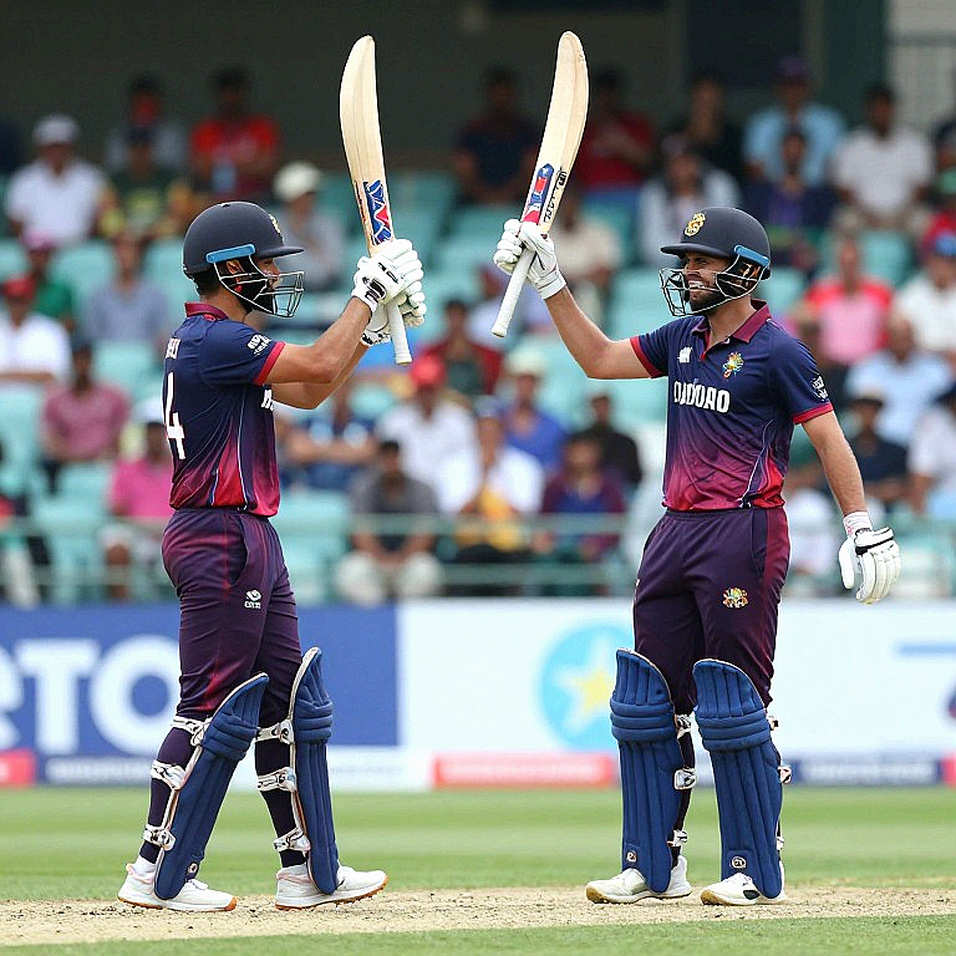
Harvey's innings is the most valuable data point of the match. Ninety off 132 balls is a strike rate near 68, the technical picture of a batter occupying the crease in a fourth innings. One innings does not prove red-ball conversion, though; his public profile leans white-ball top order. Read it as a promising signal, not a proven trend.
McSweeney's contribution is the highest-leverage individual performance here. A captain unbeaten on 57 in a 422 chase, plus the part-time spin that ended Agar's 101-ball resistance, is the kind of stacked value that makes a top-order batter more than a state scorecard line. His Test exposure makes this selection-relevant, not merely local.
One thing needs saying because several reports are framing this as survival batting. The scoreboard disagrees. At 182 for 1 South Australia are chasing, not surviving. They have been chasing since the first innings ended, and the 140-run stand is the proof.
The real contradiction is about memory. Harvey's 90 will be remembered. Nobody will remember Agar's 101 balls. Yet the arithmetic of this match was settled by those 48 runs. South Australia's 154 in the first innings is returning as interest on that ninety. And if the stand breaks on Saturday morning, the batters who follow have no experience of a 422 chase — only pressure. South Australia's pursuit is effectively a two-wicket bet: the top order finishing the job. Deadline taught me to write fast; the voice note taught me to write true. The truth is that Western Australia's route to a win also runs through the sixth and seventh wicket.
Declining the follow-on was defensible, but it handed South Australia a clean target, a settled pitch and a clear head. Remember, this is a single-match sample, and the toss result is not recorded in the available account. The storm of day two and the silence of day three may owe something to conditions as well as skill.
Saturday's forecast carries light rain. First-class cricket has no Duckworth-Lewis; here rain only eats overs, and every over lost pushes that 2.5 rate higher. The real question is not whether 240 can be scored. It is who bowls the thirtieth over of the day, and whether McSweeney plays from 57 as a man under a four-an-over squeeze or inside the calm of 2.5.
At eight in the morning Adelaide Oval is empty. Water on the grass, nobody in the stands, only the sprinklers. The board still says 422, and nobody yet knows whether by afternoon that number will be history or just another target.